
Knowledge Base/Intra-Workout & Endurance Fuel
What does a 1:0.8 carbohydrate ratio mean?
A 1:0.8 carbohydrate ratio is a glucose-to-fructose split used in endurance carbohydrate drinks. It describes how the two sources share a serving. It is not a name for maltodextrin or Cluster Dextrin.
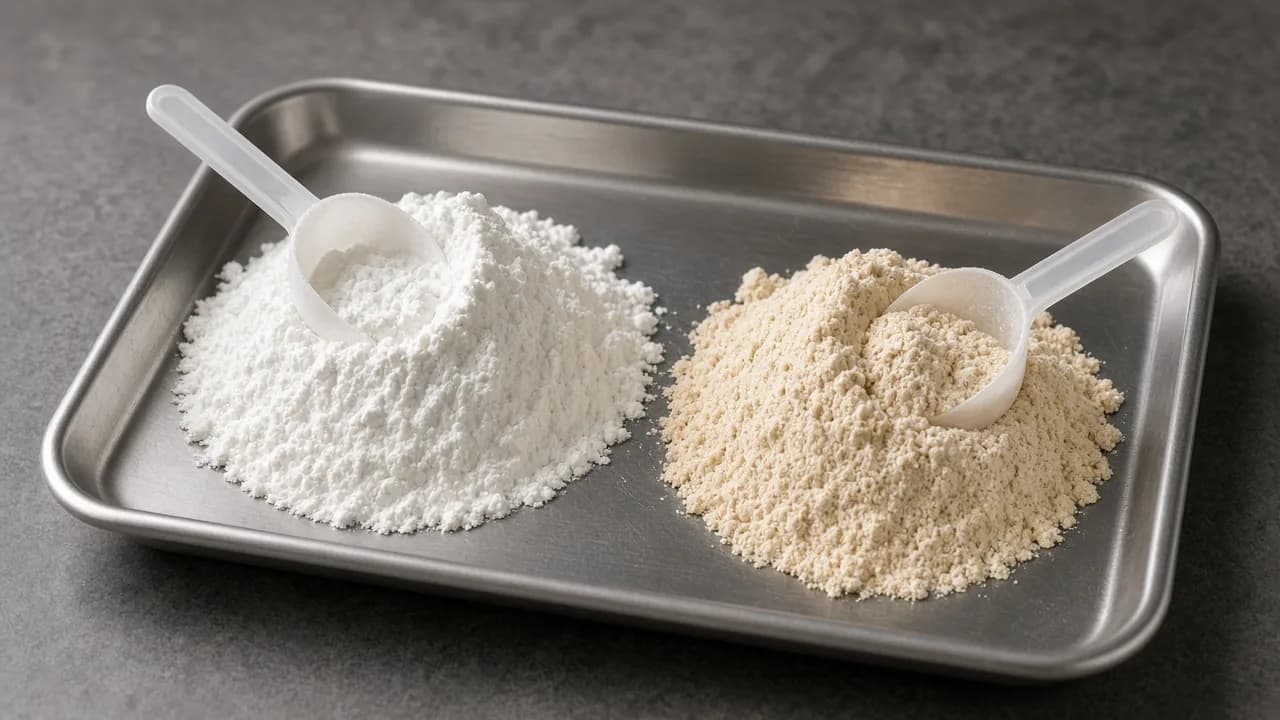
A 1:0.8 carbohydrate ratio means glucose to fructose in an endurance carbohydrate drink. For every 1 part of carbohydrate from a glucose-based source, the formula contributes 0.8 parts from fructose. It describes how the two sources share the serving. It is not a brand name, and it does not mean that maltodextrin or Cluster Dextrin is the ratio.
The glucose side and the fructose side
The glucose-based side is the part of the dose that comes from glucose, or from materials counted as glucose equivalents. In a sports nutrition brief that can be glucose itself, maltodextrin, glucose syrup solids, or another glucose-equivalent carbohydrate. Cluster Dextrin (HBCD) can sit on this side when it is used as that glucose-based contribution. It still does not define the ratio.
The fructose side is the part that comes from fructose, or from a fructose source the brief names for that job. 1:0.8 is the relationship between those two contributions in the finished serving. It is not a label on one raw material.
A simple serving example
Take 90 g of carbohydrate in one serving. At 1:0.8, the glucose-based side and the fructose side split that 90 g as 1 to 0.8.
Add the parts: 1 + 0.8 = 1.8 parts for the full serving. Each part is 90 divided by 1.8, which is 50 g. The glucose-based side is 50 g. The fructose side is 40 g. 50 to 40 is the same as 1 to 0.8.
The same split scales to other targets. For 60 g of carbohydrate at 1:0.8, the split is about 33.3 g on the glucose-based side and about 26.7 g of fructose. The ratio stays the same. Only the grams change with the serving the brand wants athletes to use.
Write both the total and the split in the brief. "90 g at 1:0.8" is clearer for manufacturing than "a 1:0.8 system" on its own. The grams decide weighing, the label and the flavour balance.
The ratio and the raw materials
1:0.8 is brief language for a split. It is not a product name, and writing it down does not point to a stock SKU. It does not require Cluster Dextrin, and it does not rule Cluster Dextrin out. The glucose-based part can be built from glucose, maltodextrin, glucose syrup solids or an equivalent, Cluster Dextrin (HBCD), or a blend of those. Positioning and cost decide.
Brands also use other ratios. Some briefs ask for a different split. Some ask for a single carbohydrate source. 1:0.8 is one common way to say how the two sides should share a serving in an endurance drink.
What changes in a real brief
State the total carbohydrate grams per serving, the ratio, for example 1:0.8, which materials are on the glucose-based side, which material supplies the fructose, and if electrolytes are in the same scoop. Taste and mixing should be checked at the full carbohydrate dose. A diluted sample hides sweetness and mouthfeel.
Three mistakes come up often. Writing "1:0.8 Cluster Dextrin", as if the ingredient were the ratio. Claiming the ratio on the pack while leaving the fructose grams out. Locking the ratio before the total carbohydrate dose is set. Set the dose first, then split it. The brief stays workable, and the pack matches the scoop.
What this means in manufacturing
Sports Nutrition Co. reads 1:0.8 as brief language for a dual-source carbohydrate split. That explanation comes first. Making the product depends on the project: sources, grams and pack are confirmed against an agreed specification. A 1:0.8 brief does not map to one stock formula, and Cluster Dextrin is not required to hit the ratio.
Related products
Related articles
Intra-Workout & Endurance Fuel
What is a high-carb drink mix / carb loader?
A high-carb drink mix, often called a carb loader in brand briefs, is a powder that puts a large carbohydrate dose into a drink for endurance use.
7 min
Intra-Workout & Endurance Fuel
What is Cluster Dextrin / HBCD?
Cluster Dextrin is highly branched cyclic dextrin (HBCD), a carbohydrate ingredient used in endurance and intra-fuel drinks. It is a raw-material choice, not a different kind of carbohydrate.
8 min
Hydration & Electrolytes
Electrolytes + Carbohydrates
Carbohydrates supply fuel. Electrolytes replace minerals. They can share a bottle if the brief says which job comes first.
7 min